
The Center for Hamstring Injury · Case Report
One sprint with his ten-year-old.
Eight-out-of-ten pain.
A 40-year-old dad tore his hamstring helping his son get ready for a soccer tournament. He had no warm-up, no ramp-up, and about fifteen years since his last real sprint. Here is what we found on ultrasound, what we did about it, and — the part most case reports skip — what we told him about getting back.
· Grade 1 biceps femoris strain· Ultrasound-guided fascial hydrodissection· New Orleans
Jacques Courseault, MD, CAQSM, FAAPMR · The Fascia Institute and Treatment Center® · New Orleans
01 · The Setup
The hamstring injury that finds you on the sideline
Hamstring strain is filed away as an elite-sport problem. It reads that way in the literature — hamstring strain injuries account for roughly 12–29% of all injuries in athletic populations, and they are stubbornly recurrent, with reported reinjury rates spanning 12% to 63% depending on the sport and how long investigators followed people.1,2
But the mechanism is not elite. The mechanism is a body asked to produce near-maximal speed without having produced near-maximal speed in a long time. A pro athlete gets there through a training error. A forty-year-old gets there by lining up on a field with his kid.
That is the patient we see constantly at the Center for Hamstring Injury — the former athlete whose body still remembers the movement and no longer has the tissue tolerance to back it up. We have taken to calling him the dad-thlete, and we say it with affection, because he is one of the most under-served patients in sports medicine. He is too fit to be treated like a sedentary patient and too detrained to be treated like an athlete.
The short version: what tears in a weekend sprint is usually the same structure that tears in a professional one. The difference is not the injury. The difference is that nobody plans the return.
02 · Presentation
The case: one unplanned sprint, no warm-up
A 40-year-old, moderately active male presented to our New Orleans clinic with posterior thigh pain. He had been helping his ten-year-old son prepare for a soccer tournament and joined in on a set of sprints. There was no warm-up, no build-up of intensity, and no recent history of high-speed running. He felt a sharp catch mid-effort and stopped.
By the time he reached us he rated his pain 8 out of 10 during ordinary daily activity — climbing stairs, bending forward to tie his shoes, getting in and out of the car. This is a detail worth pausing on. He was not limited in sport. He was limited in life. Hamstring pain that shows up when you hinge forward to reach your own foot is not a training inconvenience; it is a load-transfer problem in a tissue that is being asked to do something basic.
What we documented at intake
· Mechanism: unplanned near-maximal sprint, no warm-up, no recent high-speed running exposure
· Pain: 8/10 with stairs, forward hinge, and prolonged sitting
· Location: posterior thigh, lateral, proximal-to-mid — not at the sit bone
· Function: full weight-bearing, antalgic gait, unwilling to load into hip flexion
· Prior history: no previous hamstring injury reported
That last point matters, and it is the one piece of good news he walked in with. Prior hamstring injury is among the strongest known risk factors for another one, and the risk is front-loaded — a strain within the previous eight weeks carries a relative risk above six for a repeat.2 He had a clean history. What he did not have was a plan.
03 · Step One
Find the actual pain generator — not the region
Everything we do at The Fascia Institute runs through two steps, and they are the same two steps whether the patient is a professional fighter or a dad who can’t tie his shoes.
Most people who reach us have already had step one fail somewhere else. That is precisely why step two never worked for them. You cannot pick the right tool for a target nobody identified.
In this case, step one was straightforward. Diagnostic ultrasound performed in the room, by the physician, with the patient contracting and lengthening the muscle under the probe, identified an acute grade 1 strain of the biceps femoris. We then used sonopalpation — pressing with the transducer to reproduce his exact pain while watching the tissue — to confirm that the sonographic abnormality and the symptomatic tissue were the same structure. They were.
Why this is not the same as an MRI. An MRI is a photograph of a body lying perfectly still. Fascia hurts when it is loaded and sheared. Dynamic, physician-performed ultrasound lets us watch the tissue move, provoke the pain on purpose, and see what is actually failing. It is also why the imaging happens in the same visit as the diagnosis — not two weeks later.
When the cause genuinely cannot be found — clean imaging, unrevealing exam, nobody able to explain the pain — that is when we escalate to full Fascial Mapping. This patient did not need it. His generator announced itself.
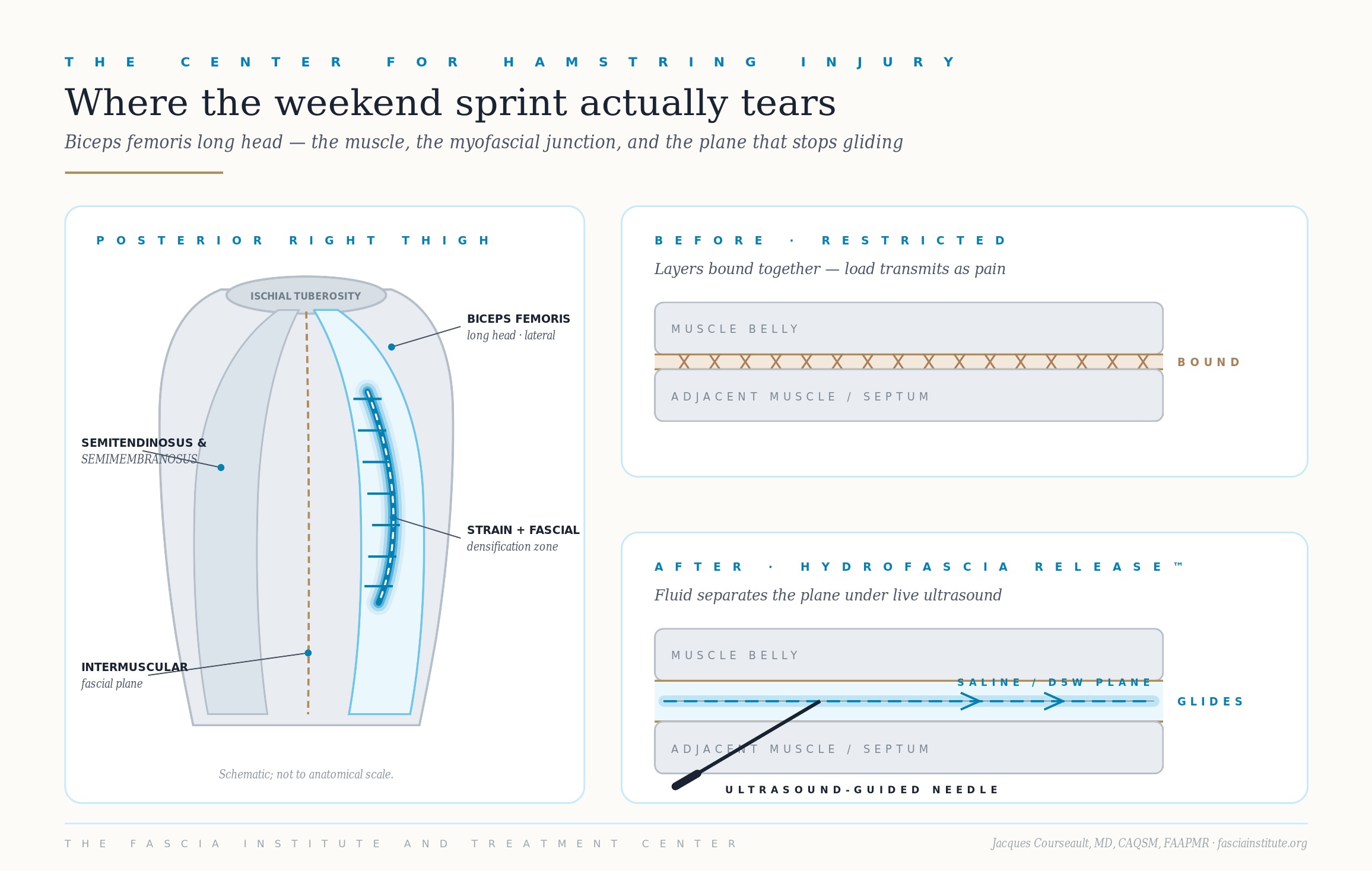
Where the weekend sprint actually tears: the biceps femoris long head and the fascial plane beside it. Schematic; not to anatomical scale.
04 · The Anatomy
What “grade 1 strain” actually means
Grade 1 sounds reassuring. It is the mildest of the traditional three grades: a small number of fibers disrupted, no loss of structural continuity, strength largely preserved. It is also the grade most likely to be dismissed — by patients, by coaches, and sometimes by clinicians.
Two things make it worth taking seriously.
First, location. The long head of the biceps femoris is the most commonly injured hamstring in sprint-type mechanisms, and the failure tends to concentrate at the myofascial junction — the transitional zone where muscle fiber hands force off to its tendon and surrounding fascia.1,3 That is a high-strain, high-shear region by design. It is also where the tissue is least forgiving about being asked for speed it has not seen in years.
Second, what happens after. A strain is not only a fiber problem. The response to injury includes inflammation and remodeling in the connective tissue surrounding and separating the muscles — and that tissue is supposed to glide. When adjacent layers lose their ability to slide relative to one another, the muscle can be structurally healed and still feel tight, restricted, and painful under load. This is the pattern behind an enormous share of the hamstrings that “never quite came back,” and it is the subject of a separate piece on why hamstring strains keep coming back.
On grading and imaging, honestly
Grading systems are useful shorthand and poor prophets. Even for the imaging finding clinicians most want to use as a prognostic marker — intramuscular tendon involvement — the evidence is modest: it is associated with roughly two additional weeks before return to play on average, with wide overlap between groups, and it has not been shown to increase reinjury rates.4,5 There is currently no MRI finding that reliably predicts an individual athlete’s timeline. We tell patients this directly, because the alternative is false precision.
05 · Step Two
Choosing the right tool for this target
Once the generator is identified, the question becomes narrow and answerable: what actually changes this tissue?
For an acute strain with a clearly restricted, painful fascial interface at the biceps femoris, the tool is ultrasound-guided fascial hydrodissection — what we perform as Hydrofascia Release™. These are not two different procedures. Hydrofascia Release is a fascial hydrodissection, performed to our protocol.
A precise stream of fluid is delivered between the layers that have stopped sliding. The fluid does the work mechanically: it separates the interface. Because the needle is under live ultrasound the entire time, the separation is watched as it happens — layers visibly parting on the screen. That is the claim worth making about this procedure and the one we hold to: it is the only way to release fascial adhesions in real time, seen at the moment it occurs, rather than inferred afterward from how someone feels.
The technique for chronic hamstring injury was first described and published by Dr. Courseault in Current Sports Medicine Reports in 2019.6 Independent groups have since reported on ultrasound-guided fascial hydrorelease for persistent post-hamstring-injury pain, with pain scores falling from a mean of 10 to 0.86, most patients needing one to four sessions, and no adverse events over a mean follow-up of roughly six and a half months.7 Mechanistically, the current reading is that the mechanical separation — not the chemistry of the injectate — is doing most of the work.7
It is not the only tool, and it is not always the tool. Some hamstrings need ProloBoost™ dual PRP or prolotherapy for a degenerative tendon. Some need biomechanical work because the hamstring is failing for a reason that lives at the hip or the foot. Some need time and progressive loading and nothing injected at all. The point of step one is that you get to make that choice on evidence instead of on habit.
06 · The Procedure
What the visit actually looked like
Total chair time was short. There was no sedation, no incision, and no immobilization afterward. He walked out of the building under his own power the same afternoon, which is typical — and which is also exactly the moment where patients start making decisions we would rather they not make alone.
8 → 2
Pain score at 24 hours
1
Procedure performed
0
Days of immobilization
4+
Weeks to full sprint, by criteria
07 · Results
Eight to two in twenty-four hours
He reported improvement in pain and range of motion immediately following the procedure. He returned to clinic the next day for follow-up and rated his pain 2 out of 10, down from 8. Stairs were manageable. He could hinge forward to reach his shoes. Daily activity was essentially restored.
That is a good result and we are glad to report it. It is also the point in a case report where we think most write-ups quietly mislead people, so we are going to be plain about it.
Pain relief is not the same as tissue healing. A 24-hour drop from 8 to 2 tells us we found the right target and that the mechanical restriction was a major contributor to his symptoms. It does not tell us that a strained muscle has finished remodeling. Those are two different clocks, and the second one does not care how good the first one feels.
This is the single most dangerous window in hamstring care. The patient feels dramatically better, the calendar says it has been one day, and the biology has not moved much at all. Feeling good is precisely what gets a hamstring reinjured — and reinjuries cluster in the period right after return.2
08 · Return to Activity
Why we slowed him down
We told him what we tell professional athletes in the same position: the procedure bought you comfort and mechanics. It did not buy you a shortcut past healing. Progression is earned by criteria, not granted by the calendar.
His instructions were straightforward — minimal hamstring loading at first, no running and no jumping, then a graded increase in load and intensity as tolerated, with pain as a hard ceiling rather than a suggestion. Symmetrical pain-free strength, full pain-free range under load, and a clean progression through submaximal running come before anything that looks like a sprint.
The progression, in order
· Pain-free daily activity and full weight-bearing gait
· Isometric then isotonic hamstring loading, low intensity, no pain
· Progressive eccentric work — the exposure that actually builds tolerance
· Submaximal running, then graded acceleration, both symptom-free
· Provocative end-range testing before high-speed running is cleared
· A planned sprint exposure — not an accidental one
On timing, we have deliberately revised what we would have said a few years ago. Based on the biology of muscle healing, a minimum of about four weeks before full return to sport is a reasonable floor after a grade 1 or 2 hamstring strain, even when symptoms resolve quickly.8 And when clinicians add a provocative end-range assessment — the Askling H-test — to their return-to-sport criteria rather than relying on standard strength and palpation alone, reported reinjury rates fall to roughly 1–4%.9 The test’s whole value is that it detects remaining injury signs when ordinary clinical examination has already declared the athlete fine.
For context on how mechanism shapes timelines: in elite footballers, sprint-type hamstring injuries returned at an average of about 23 days, while stretch-type injuries averaged 43.9 Those are averages in professionals with daily medical supervision. A dad with a job and two kids is not in that dataset.
09 · The Pattern
The dad-thlete problem is really a load problem
The instinct is to blame age, and age is not nothing — it is a well-recognized, non-modifiable risk factor for hamstring strain. But it is not the interesting part of this case. The interesting part is the shape of the exposure.
High-speed running is the thing that injures hamstrings and also the thing that protects them. Both under-exposure and over-exposure raise risk: in elite Gaelic footballers, athletes completing roughly six to ten maximal-velocity efforts per week were at lower risk than those completing fewer than five.10 Sprinting is not the danger. Unfamiliar sprinting is.
The dad-thlete lives permanently at the low end of that curve and then, two or three times a year, spikes to the top of it with no ramp: a field day, a pickup game, a kid who wants to race. The former-athlete part of the story makes it worse, not better, because the motor pattern is still there. He knows exactly how to sprint. His tissue no longer knows how to absorb it.
Modifiable, and worth knowing: insufficient warm-up, low eccentric strength, exercise volume spikes, fatigue, reduced flexibility, and pelvic and core control all sit on the modifiable side of the risk ledger.11 Age and prior injury do not. Spend your effort on the first list.
10 · Prevention
What we told him to do before the next sprint
He is going to sprint again. Telling a forty-year-old father not to run with his son is not medicine, it is surrender. The job is to make the next one survivable.
The caveat we always add: the Nordic evidence is strong in the aggregate and contested in the details — a methodological reappraisal concluded the protective effect is best described as conditional rather than settled, given the risk of bias in the underlying trials.12 We tell patients that because we would rather they trust the next thing we say.
11 · The Principle
The stakes are different. The process is identical.
We do specialize in athletes. The Center for Hamstring Injury exists because Dr. Courseault published the hamstring hydrodissection technique and because professional athletes started flying in for it. Some of those patients have stages, and when they win we are openly proud of it.
But an athlete with a platform is a megaphone, not a different service. There was nothing special about how we approached the fighter chasing a title compared with how we approached this dad. Same scan. Same two steps. Same honesty about timelines.
A pro chasing a title, a teacher who cannot get through a school day, a nurse on her feet for twelve hours, a grandparent who wants to pick up a grandchild, a forty-year-old who wants to run with his kid without it costing him three months — the stakes are different every single time. The process does not change.
And we will tell you when the answer is no. Some injuries are genuinely beyond what any procedure fixes, and saying so is part of the job.
Next Step
If your hamstring never fully came back
Whether the injury happened last week or five years ago, the first question is the same: what is actually generating the pain? We answer that with dynamic ultrasound in the room, on the first visit, and then we tell you honestly what will and will not change it.
The Fascia Institute and Treatment Center® · 2520 Harvard Ave Ste 2B, Metairie, LA 70001 · (504) 704-1254
Related Reading
More from the Center for Hamstring Injury
References
1. Erickson LN, Sherry MA. Rehabilitation and return to sport after hamstring strain injury. J Sport Health Sci. 2017;6(3):262–270.
2. Heiderscheit BC, Sherry MA, Silder A, et al. Hamstring strain injuries: recommendations for diagnosis, rehabilitation, and injury prevention. J Orthop Sports Phys Ther. 2010;40(2):67–81. See also Martin RL, et al. Hamstring strain injury in athletes: clinical practice guidelines. J Orthop Sports Phys Ther. 2022;52(3):CPG1–CPG44.
3. Danielsson A, Horvath A, Senorski C, et al. The mechanism of hamstring injuries — a systematic review. BMC Musculoskelet Disord. 2020;21:641.
4. van der Made AD, Almusa E, Whiteley R, et al. Intramuscular tendon involvement on MRI has limited value for predicting time to return to play following acute hamstring injury. Br J Sports Med. 2018;52(2):83–88. PMID 28903949.
5. van der Made AD, Almusa E, Reurink G, et al. Intramuscular tendon injury is not associated with an increased hamstring reinjury rate within 12 months after return to play. Br J Sports Med. 2018;52(19):1261–1266. PMID 29654058.
6. Courseault J, Kessler E, Moran A, Labbe A. Fascial hydrodissection for chronic hamstring injury. Curr Sports Med Rep. 2019;18(11):416–420. PMID 31702723.
7. Shiwaku K, Otsubo H, Nishikawa D, et al. Ultrasound-guided fascial hydrorelease for persistent pain after hamstring injury. J Funct Morphol Kinesiol. 2025;10(3):318. PMID 40843849.
8. Pieters D, Wezenbeek E, Schuermans J, Witvrouw E. Return to play after a hamstring strain injury: it is time to consider natural healing. Sports Med. 2021;51(10):2067–2077. PMID 34143413.
9. Askling CM, Nilsson J, Thorstensson A. A new hamstring test to complement the common clinical examination before return to sport after injury. Knee Surg Sports Traumatol Arthrosc. 2010;18(12):1798–1803. Return-to-play timelines and reinjury rates as summarized in reference 1.
10. Malone S, Roe M, Doran DA, et al. High chronic training loads and exposure to bouts of maximal velocity running reduce injury risk in elite Gaelic football. J Sci Med Sport. 2017;20(3):250–254.
11. Wing C, Bishop C. Hamstring strain injuries: incidence, mechanisms, risk factors and training recommendations. Strength Cond J. 2020;42(3):40–57.
12. van Dyk N, Behan FP, Whiteley R. Including the Nordic hamstring exercise in injury prevention programmes halves the rate of hamstring injuries. Br J Sports Med. 2019;53(21):1362–1370. PMID 30808663. Contrasting methodological reappraisal: Impellizzeri FM, et al. J Clin Epidemiol. 2021;140:111–124. PMID 34520846.
13. Tedeschi R, Giorgi F, Donati D. Sprint training for hamstring injury prevention: a scoping review. Appl Sci. 2025;15(16):9003.
Case details are published with the patient’s permission; identifying information has been omitted. This single case describes one patient’s course and is not a guarantee of results. Individual outcomes vary with injury severity, tissue involvement, prior injury history, and adherence to a graded return-to-activity program. This article is for educational purposes and is not a substitute for individual medical evaluation. Ultrasound-guided procedures carry risks that should be discussed with your physician.


